




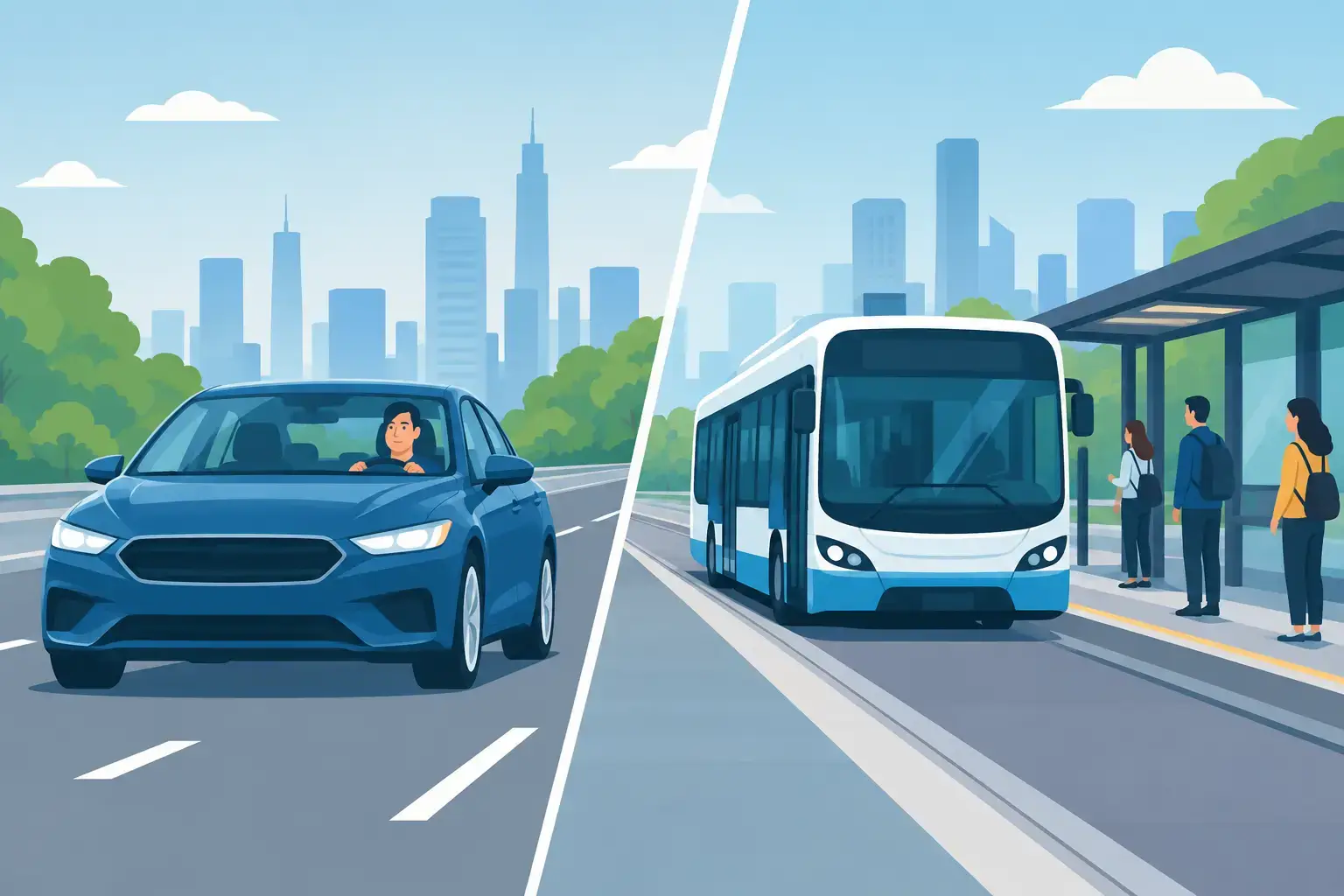
A 6am Stansted flight, a child’s appointment in Royston, or a meeting where arriving late is not an option can make private car versus public transport a very practical decision. The best choice is rarely about one being universally better. It comes down to where you are going, who is travelling, how much luggage you have and how much certainty you need.
For some journeys, a bus or train is the sensible lower-cost option. For others, a car – whether your own vehicle or a pre-booked private-hire taxi – removes several changes, delays and worries from the day. Knowing the trade-offs helps you choose with confidence rather than relying on luck.
Private car versus public transport: start with the journey
Public transport works well when services run frequently, stops are close by and your destination is near a station or on a direct route. A straightforward town-to-town journey in the middle of the day may be easy to plan and good value, especially for one passenger travelling light.
The picture changes when the journey begins in a village, ends at an airport terminal or involves travelling outside regular service times. In and around Buntingford, reaching a rail station or connecting between buses can add a surprising amount of time. A timetable may show a short journey, but it does not always include the walk to the stop, waiting time, missed connections or the final leg from the station.
A private car offers door-to-door travel. You choose the collection point, set the time and travel directly to the destination. For an airport journey, that can mean leaving home with enough time to spare without building the day around several connections.
There is also an important difference between using your own car and booking a private-hire vehicle. Driving yourself gives you control, but it also means parking, fuel, traffic, navigation and the return journey remain your responsibility. A pre-booked taxi gives you the privacy and direct route of car travel while leaving the driving to someone else.
Cost is more than the ticket price
A bus or train fare can look cheaper at first, and for a solo journey on a direct route it often is. That is worth recognising. Public transport can be a good option when the schedule suits you and you do not need much flexibility.
However, compare the whole cost before deciding. If you drive to a station, include fuel, parking and any drop-off charges. If a bus does not reach your final destination, factor in the cost of a taxi for the last part of the trip. Airport travel can bring extra expenses too, particularly long-stay parking, terminal access charges and the cost of getting home after a delayed return.
For couples, families and small groups, private transport can become more competitive because the vehicle cost is shared. A minibus can be especially practical when several people are travelling together with suitcases, prams or sports equipment. Instead of buying separate fares and trying to stay together across changes, everyone can travel in one vehicle.
The cheapest option is not always the best value. If a lower fare requires an extra hour, multiple changes and the risk of missing an important appointment, a direct journey may be the more affordable choice in real terms.
Timing and reliability matter most on fixed journeys
Public transport depends on timetables, and timetables are not guarantees. Road congestion, engineering works, cancellations and reduced evening or weekend services can all affect a journey. That does not make public transport unreliable by default, but it does mean you need a backup plan when the arrival time matters.
This is particularly relevant for flights, hospital appointments, work shifts and business meetings. Missing a connection can be inconvenient on a shopping trip. Missing a connection before an international flight can be expensive and stressful.
A pre-arranged private-hire journey provides a clearer plan. Your driver collects you at the agreed time, handles the route and takes account of local road conditions. For early starts or late returns, this certainty can be more valuable than a small difference in fare.
For airport passengers, it is sensible to allow extra time regardless of how you travel. Flights, check-in requirements and security queues can change. The advantage of a booked car is that you control the departure time from your door, rather than working backwards from the first available bus or train.
When public transport is the better choice
There are plenty of occasions when public transport makes sense. A regular commuter with a direct train service may prefer the predictable routine. A student travelling alone during the day may value a lower fare. If parking is difficult at the destination, a train or bus can also remove the need to find a space.
It may also suit journeys where you are happy to read, listen to something or simply avoid driving. For some people, especially on busy city routes, leaving the car at home is a welcome relief.
The key question is whether the service fits your actual schedule. If it does, public transport can be simple and effective. If the trip involves awkward connections, limited services or a deadline, its lower upfront cost may come with less flexibility.
Comfort is not a luxury on longer trips
Comfort affects how a journey feels, especially when children, older relatives or luggage are involved. On public transport, you share space, follow fixed stopping patterns and may need to stand at busy times. There may be limited room for large cases, pushchairs or several bags.
In a private car, you travel with the people you know and can usually be collected from the most convenient point. There is no need to carry luggage between platforms, wait outside in poor weather or worry about keeping a group together at each change. For a family travelling to Stansted Airport, that practical difference can set the tone for the entire holiday.
Business travellers often value privacy as well as comfort. A direct car journey gives time to prepare for a meeting, make a quiet call where appropriate or simply arrive feeling less rushed. It is a small detail, but it can make a difference when professionalism matters.
Safety and confidence on unfamiliar routes
Both car travel and public transport can be safe ways to travel, but confidence often comes from knowing exactly what will happen next. If you are visiting an unfamiliar area, travelling with children or returning late, a door-to-door service can feel more reassuring than navigating stations and stops in the dark.
A knowledgeable local driver can also avoid the pressure of unfamiliar roads, diversions and parking restrictions. With Buntingford Taxis, passengers can pre-arrange collection details and choose a suitable vehicle for the journey, which is useful when timing, space and clear communication matter.
For your own car, safety also includes being fit to drive. After a long flight, an evening event or an exhausting day, driving home may not be the wisest part of the plan. Booking transport for the return journey can be a sensible decision rather than an indulgence.
The environmental question needs a fair comparison
Public transport can reduce the number of individual cars on the road, particularly when buses and trains are well used. For a single traveller on a direct service, it may be the lower-impact choice.
Yet the comparison is not always straightforward. A fully occupied private-hire minibus replacing several separate car journeys is a different proposition from one person driving alone. Sharing a vehicle with family, colleagues or friends can reduce the number of cars needed, while also making the journey easier to organise.
Choose the option that avoids unnecessary mileage where you can. Combining journeys, travelling together and selecting a direct route are all practical ways to make transport choices more efficient.
Make the choice that protects your plans
Ask yourself four simple questions before booking or setting off: Is there a direct service? Do I need to arrive at a fixed time? How much luggage or how many people are travelling? What happens if there is a delay?
If the answers point to a frequent, direct route and a flexible schedule, public transport may serve you well. If you need a reliable collection time, a direct airport transfer, room for a group or a comfortable journey from door to door, private transport is often the calmer option.
The right journey is the one that gets you there safely, comfortably and with enough time to spare to enjoy what you travelled for.
